
Every knitting project starts with gathering the right tools first! A big, cozy poncho is a great fall knitting project, and this one is easy and a lot of fun. Let’s gather the right tools first. This post covers choosing yarn, a pattern holder, and a project bag. It also covers picking needles and a cable needle for chunky, cabled knitting. Next are the small essentials: stitch markers, measuring tools, and yarn cutters. A few nice extras round things out, too: a row counter, a progress keeper, and a simple blocking system.
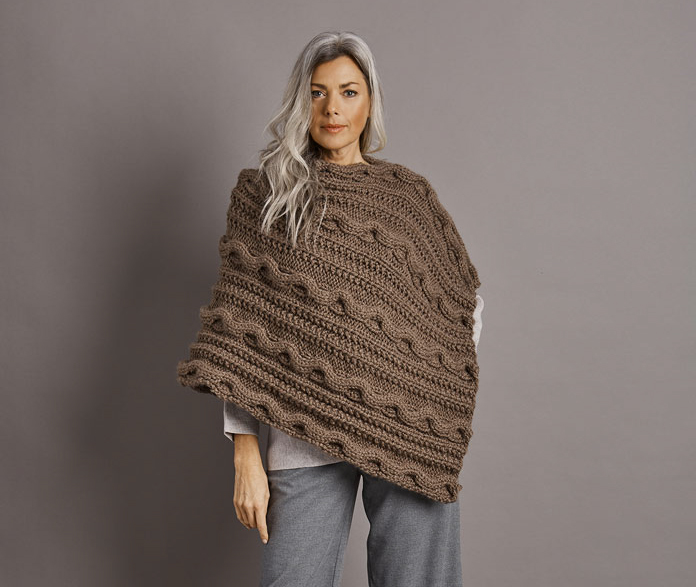
Knit this Cabled Poncho from Lion Brand with Wool-Ease Thick & Quick yarn with a free pattern and advice on what knitting tools to use to make knitting it quick, easy, and fun!
materials
yarn
- worsted-to-super-bulky weight yarn recommended in the pattern, in a color that’s genuinely enjoyable to knit with
tools
- a pattern holder, for propping up and tracking a printed or digital pattern
- circular knitting needles sized to the yarn, such as a US 13 [9mm], 32″ [81.3cm] circular, for evenly distributing bulky stitches
- a cable needle sized to match, with a bit of grip to keep stitches from sliding
- large locking or ring stitch markers, for tracking pattern repeats and marking mistakes
- a retractable measuring tape and a straight gauge ruler
- small scissors or a yarn cutter
- a row counter
- a spare stitch marker or a small charm, to use as a progress keeper
- blocking mats and either T-pins or pin-style knit blockers
- a roomy project bag, without Velcro or anything else that could snag the yarn
gauge
- 14 sts = about 4″ [10cm] over Rows 1-12; remember to swatch, even for a poncho!
pattern
- download PDF for the Cabled Poncho here
Choose a yarn, pattern holder, and project bag
Use the yarn recommended in the pattern, since substituting can be risky without some experience. Pick something enjoyable to work with, since hours of knitting with yarn you dislike rarely ends well. A higher price doesn’t guarantee better quality, so grab a yarn you love at a good price. Skip anything musty, mildewed, or moth-eaten and start fresh instead.
A pattern holder keeps a printed page or tablet propped up and on track, often with a magnetic strip to mark off rows as you complete them. It also protects the pattern on the go. A good project bag rounds out the starting kit: roomy enough for the yarn, project, and every accessory, without Velcro that could snag the yarn. A few pocket sizes and a waterproof exterior help too.

Learn about how you can quickly and professionally knit up any project using this KNITTER’S PRIDE Pattern Holder and a few more special tools of the trade; Lion Brand Wool-Ease Thick & Quick, Vivace Accessories Bag; Cabled Poncho free pattern
Pick the right needles
Wooden or bamboo needles hold stitches securely and cost less, a friendly starting point for newer knitters. Metal needles run cooler to the touch and let stitches glide more smoothly, building even tension and faster knitting with some practice. A wide, heavy project like a poncho knits best on circular needles, since the cord distributes the weight better than straights do. A circular around US 13 [9mm] and 32″ [81.3cm] long suits bulky yarn well. Some circulars even mark 1″ [2.5cm] increments right on the cord, handy for checking gauge as it shifts.
A cable needle needs just enough grip to keep stitches from sliding off too soon. Grooved wooden cable needles add helpful texture. U-bend styles hold stitches with a deep curve instead, which suits newer cablers well. Size the cable needle to match the working needles.
Add the small essentials
Large locking or ring stitch markers earn their keep in a few ways. They track cable pattern repeats and reduce mistakes. A locking marker can also flag a spot that needs fixing later, holding a dropped stitch in place until there’s time to return to it. A retractable tape measure tracks a project’s growing length, while a straight gauge ruler measures a swatch more precisely. One with sized holes doubles as a quick way to identify an unlabeled needle.
Small, sharp scissors or a dedicated yarn cutter finish out the essentials. A pendant-style cutter with its blade tucked safely away travels well anywhere, with no exposed edge to nick a finger or worry about on a plane.
Round out the kit
A row counter takes the guesswork out of tracking rows through a busy pattern with several increases and decreases at once. Clicking one forward beats searching for a pencil, and a counter rarely wanders off the way loose paper does. Some styles lock against accidental clicks, some run as a phone app, and some wear right on a finger as a ring.
A progress keeper is really just a special stitch marker, clipped onto a stitch at the start of a session to show how much ground gets covered. It’s a small morale boost through the long stretches where a project seems to barely grow. Any charm or a spare locking marker works, as long as it stands apart from the regular markers in use.
Blocking brings a cabled project to life. Interlocking foam mats make a flat, pin-friendly surface of any size without damaging furniture. Simple T-pins work well and cost little. Pin-style knit blockers work faster, with several pins built into one handle, leaving a neater, more even edge on a large project.
Put it all to work
With yarn, needles, and every small accessory gathered, the poncho came together quickly on big needles and bulky yarn. A few small pattern errors needed correcting early on, and a couple of stitches went the wrong way here and there. Marking each one with a stitch marker made those easy fixes later. Blocking brought the cables fully to life, and a simple shoulder seam finished the poncho into its final oversized shape.
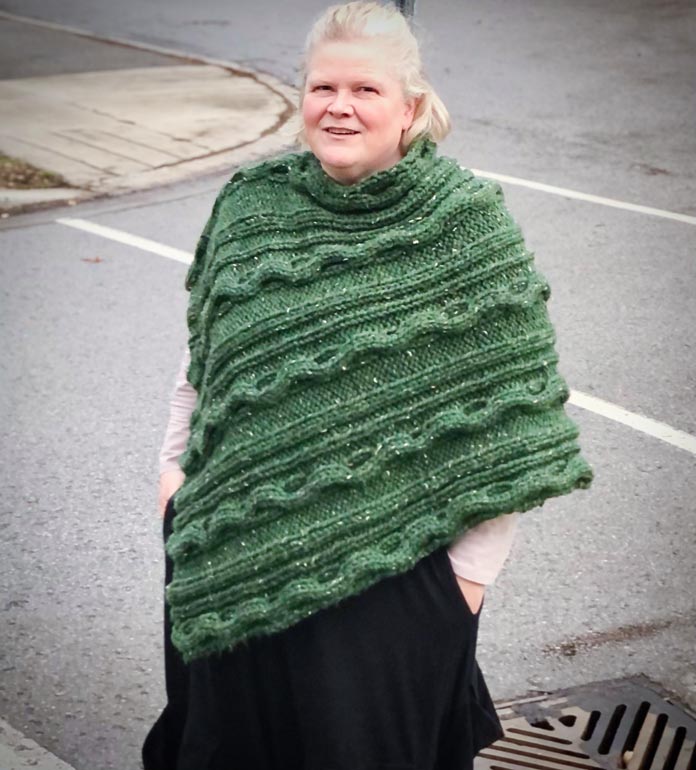
Tada! I’m ready to face the cool, crisp winds of fall in my new Cabled Poncho.