
Not all sock weight fibers are created equal. What makes some truly stand out is a perfectly balanced 4-ply twist, combined with a fiber blend that delivers both softness and durability. A well-constructed sock weight made from superwash merino wool, rayon from bamboo, and nylon in a 50/25/25 ratio hits a sweet spot: it has enough drape and sponginess to knit beautifully at a wide range of gauges, making it useful for far more than just socks.
This series explores the versatility of Wacki Saki Simple Sock in three different projects: a pair of ankle socks, a top-down raglan baby sweater, and a finishing technique called the rolled ribbing neckline.
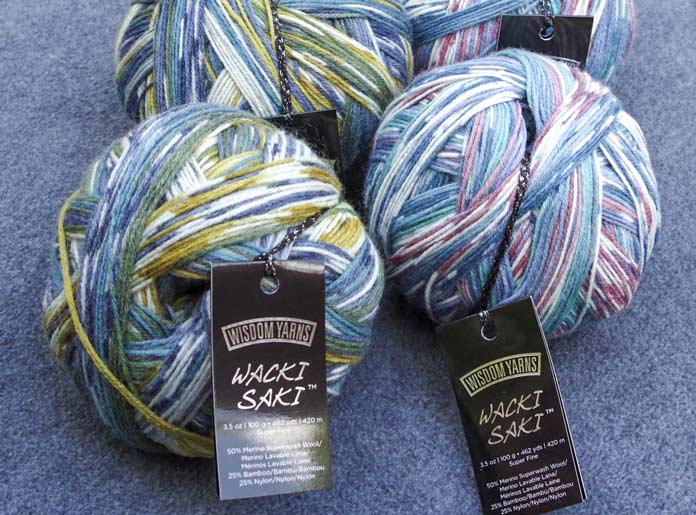
No need for a ball winder or swift as Wacky Saki is already wound up on balls.
Swatching Across Gauges
One of the most valuable things you can do before casting on is test the same fiber at different needle sizes. Swatching at a looser gauge on 4mm needles yields approximately 20 stitches per 4 inches, producing a relaxed fabric with lovely drape and a faux-Fair Isle stripe effect. Tightening to 2mm needles results in 40 stitches per 4 inches, a very dense and exceptionally durable fabric. A middle-ground gauge at 2.75mm needles gives approximately 31 stitches per 4 inches, producing a comfortable, stretchy fabric with good stitch definition, ideal for socks worn by adults.
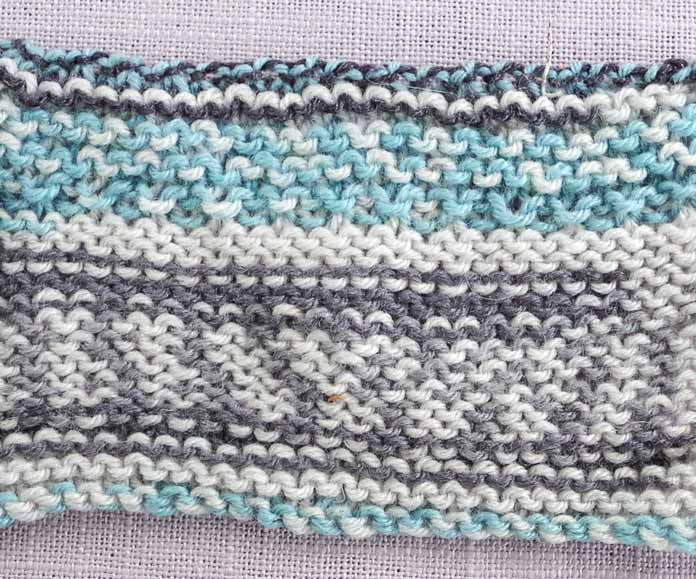
Reverse stockinette stitch and garter stitch rows on a swatch knit on 4mm needles.
Free Pattern: Ankle Socks with a German Short-Row Heel
The German short-row heel is an excellent choice for knitters who want a smooth, angular turn with no gaps or wraps to pick up. The technique uses a knit or purl “hitch stitch” created by slipping the first stitch of each row, tugging the yarn firmly over the needle tip, and working back across the remaining stitches. As the heel is built row by row with decreasing stitch counts, and then reconstructed by working the double hitch stitches together in pairs, a clean and precise heel cup emerges.
materials
- sock weight fiber (superwash merino wool, rayon from bamboo, nylon blend), approximately 100g, 400m per 100g
- US 0 [2mm], US 1 [2.25mm], or US 2 [2.75mm] circular needles, or 4 double pointed needles
- stitch markers
- waste yarn for holding stitches
- tapestry needle
The pattern is written for 56 stitches using a cable cast-on, with twisted ribbing at the cuff. Set-up rounds add 4 instep stitches before the heel begins, and these are decreased back out after the heel is complete. At a gauge of 31 stitches per 4 inches, one full skein of approximately 100g yields two pairs of ankle-length socks. At a slightly looser gauge with a larger needle, the same skein produces a chunkier fabric with wider stripes.
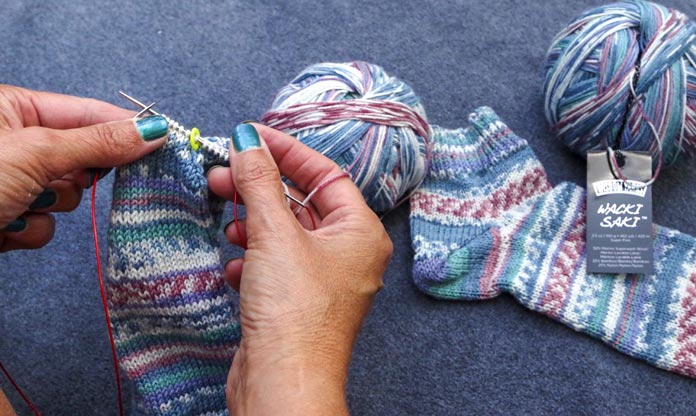
The faux Fair Isle patterns that work up with the space-dyed Wacki Sacki yarn look good at any gauge.
Free Pattern: Top-Down Raglan Baby Sweater
Knitting a sock weight fiber at worsted weight tension is entirely possible when the fiber has excellent stitch memory and a resilient twist. Working this sweater on 4mm needles at a gauge of 20 stitches per 4 inches, the resulting fabric is soft enough for a baby and structured enough to hold the faux Fair Isle color patterning clearly. The sweater is knit top-down in the round, beginning at the neckline and increasing along four raglan lines to shape the yoke. Sleeves are separated onto holders, and underarm stitches are cast on before the body continues in the round. Mild hip shaping adds two stitches every few rounds to create a gentle flare. Sleeves are worked from the holder downward, with occasional underarm decreases to taper the shape.
sizes: 6 months, 9 months, 18 months
finished chest: 18¾” (20¾”, 23″) [48 (53, 58.5) cm]
gauge: 20 stitches and 26½ rows per 4 inches in stockinette in the round
materials
- sock weight fiber (superwash merino wool, rayon from bamboo, nylon blend), 1 skein approximately 100g, 400m per 100g
- US 6 [4mm] circular needle, 16″ or longer, or double pointed needles
- 2 stitch holders
- 4 stitch markers
- 2 lengths of scrap yarn
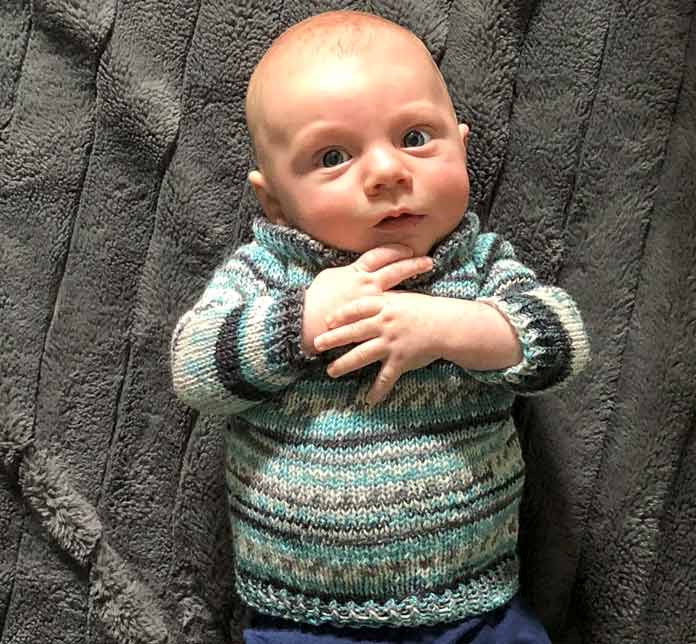
This is the 6-month size of the top-down Wacki Saki sweater.
Finishing Technique: The Rolled Ribbing Neckline
A rolled neckline solves the perennial problem of a crew neck opening that is too tight to pull over a baby’s head comfortably. Rather than relying on a stretchy bind-off or larger needles alone, the rolled neck is worked by casting on provisionally with scrap yarn, then working twisted ribbing for twice the desired visible depth plus one turning row. The provisional cast-on is then undone, the live stitches are placed on a needle one size smaller than the main needle, and both sets of stitches are held together and worked off in pairs to join the two edges seamlessly. Twisted ribbing has the added benefit of clinging naturally without needing to drop down a needle size, making it especially practical for small garments that need to stretch enough to go on but snug enough to stay put.
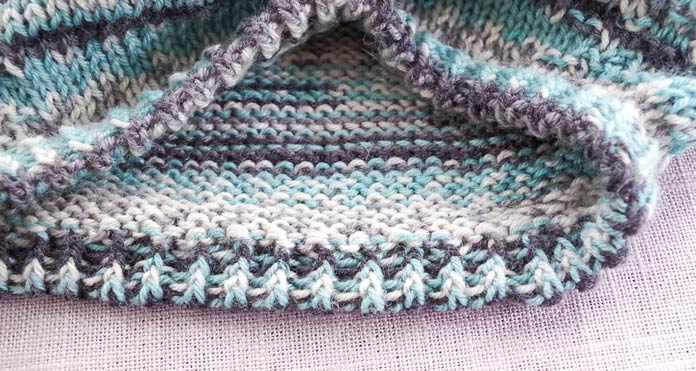
A rolled neckline makes this baby sweater a cinch to pull over the wearer’s head.